


Amidst rising food import bills and growing climate concerns, the Middle East is witnessing a quiet revolution in agriculture, led by vertical farming. In tech-forward hubs like the UAE, Saudi Arabia, and Qatar, innovative farming systems such as hydroponics and aeroponics are enabling year-round crop production without relying on soil or large volumes of water.
As urban spaces turn into controlled-environment farms and government-backed sustainability agendas push agri-tech forward, choosing the right system is more critical than ever. This blog breaks down both methods to help stakeholders navigate the best fit for Gulf-region conditions and commercial goals.
Foundations of Vertical Farming in Arid Climates
Hydroponics involves growing plants in nutrient-enriched water without soil. Roots are submerged in or misted with water, allowing for direct nutrient absorption. It's ideal for leafy greens and herbs, offering consistent yields and relatively simple maintenance.
You can also explore our blog, Hydroponics in Sustainable Food Production.
Aeroponics, on the other hand, suspends plant roots in the air, periodically misting them with a nutrient-rich solution. This system delivers superior oxygenation, faster plant growth, and efficient water use, but it requires precise environmental control and technical expertise.
Both methods are foundational to modern vertical farming systems, especially in regions like the Middle East, where traditional agriculture is challenged by extreme heat and limited natural resources.
| Feature | Hydroponics | Aeroponics |
|---|---|---|
| Water Use | Low | Ultra-low |
| Nutrient Delivery | Stable and direct | High efficiency, atomized delivery |
| System Complexity | Moderate | High (requires fine-tuning) |
| Maintenance Needs | Lower, easier to manage | Higher, frequent monitoring is required |
| Yield Potential | High | Very High |
| Risk of Failure | Moderate | High (due to technical sensitivity) |
| Cost | Lower setup and operation | Higher upfront investment |
Hydroponics offers reliability and ease of use, making it ideal for beginners or scalable projects. Aeroponics maximizes yield and efficiency but demands higher technological input and risk management.
Climate and Environmental Suitability in the Middle East
Hydroponics offers a robust solution for these conditions, especially in environments with limited technological infrastructure. Its simplicity, efficiency, and adaptability make it ideal for mid-scale operations and urban farming modules across the Gulf.
Aeroponics, on the other hand, caters to next-generation smart farms. Its advanced system delivers nutrients through a fine mist, drastically reducing water usage while maximizing plant health and yield. This makes it especially appealing for regions heavily investing in agritech innovation and water-smart agriculture.
When paired with climate-control systems and renewable energy sources, both hydroponics and aeroponics become powerful tools to transform environmental limitations into year-round, scalable food production, paving the way for sustainable agriculture in the Middle East.
On the Ground: How Vertical Farming is Thriving in the Middle East
VeggiTech, a UAE-based agritech company, exemplifies success in hydroponic farming by offering protected hydroponics and grow-light-assisted solutions adapted for desert climates. Their farms supply pesticide-free produce to urban markets and act as hubs for community education and agritech innovation.
In contrast, aeroponics startups in Qatar and Oman are working with government-backed smart city initiatives to build high-yield, water-saving systems for public institutions and hospitality sectors.
These real-world examples highlight the adaptability of both technologies. Hydroponics leads in practical deployment across supermarkets and vertical farms, while aeroponics is gaining traction among institutions seeking peak performance and cutting-edge innovation.
Cost Analysis and Investment Considerations
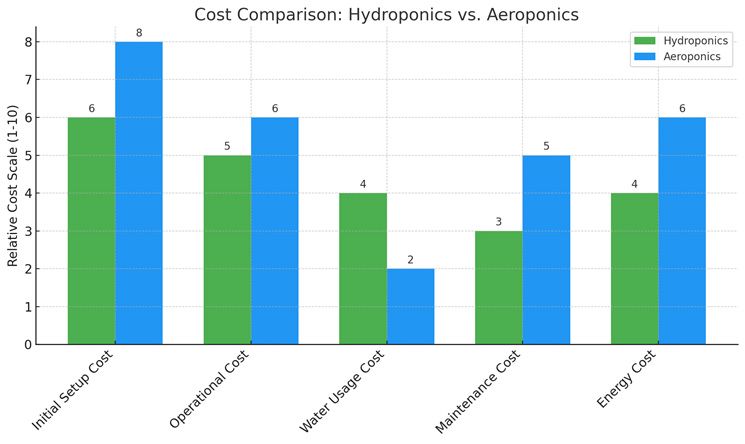
Hydroponics typically requires lower capital investment, making it more accessible for startups and pilot projects. Operational costs are manageable, with straightforward nutrient and lighting requirements.
Aeroponics, while offering faster growth and higher yields, demands a higher upfront investment in misting equipment, control systems, and backup technologies. Maintenance costs can also be higher due to technical complexity.
However, the return on investment (ROI) may be faster with aeroponics under ideal conditions. Regional grants and government subsidies for smart agriculture in the Middle East can help offset initial costs for both systems.
Choosing the right system ultimately depends on your scale, risk appetite, budget, and long-term vision.
Final Verdict: Which Should You Choose?
Hydroponics presents a reliable and scalable starting point for individuals and businesses entering the vertical farming space. Its relatively simple setup, lower initial costs, and proven performance in the Middle East make it ideal for both residential growers and commercial farms. With a well-established footprint across the UAE and the Gulf region, hydroponics offers consistent results and a smoother learning curve, making it the preferred choice for those prioritizing stability and ease of operation.
Aeroponics, on the other hand, is designed for advanced growers and tech-driven agribusinesses aiming to push the boundaries of efficiency, precision, and water conservation. By delivering nutrients as a fine mist directly to plant roots, aeroponic systems can produce higher yields with significantly less water, an appealing benefit in water-stressed regions. However, these systems require technical know-how, consistent monitoring, and more complex infrastructure, making them better suited for smart farming setups and high-investment operations.
When choosing between hydroponics and aeroponics, consider your goals, location, technical capabilities, and budget. Both systems are powerful tools in the shift toward climate-resilient and sustainable agriculture in the Middle East, and each plays a vital role in transforming how food is grown in this region.
Ready to Grow Smarter at the 6th GVF Dubai?
Position your business at the forefront of agricultural innovation. Whether you're exploring hydroponics or investing in advanced aeroponic systems, the time to lead the future of food in the Middle East is now. Join industry pioneers, discover cutting-edge solutions, and secure your competitive edge at the 6th Global Vertical Farming Show 2025 — the region's definitive platform for next-gen agritech.
