


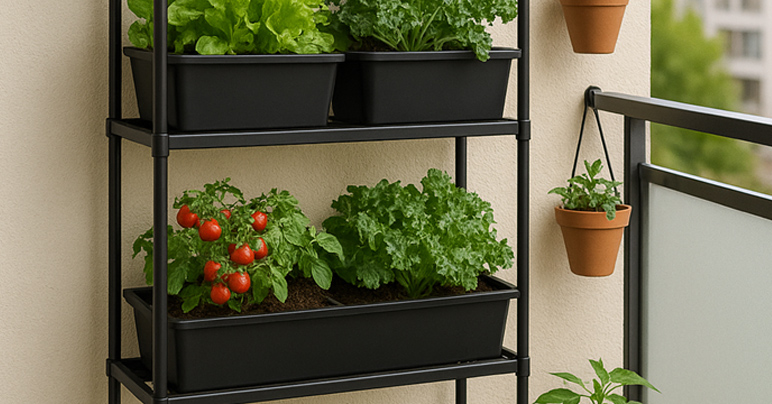
Lush green farms, vertically growing fresh fruits and vegetables and lights all over the farm may not be witnessed by everyone easily, but yes, at least all of us can have that one mini version of that huge setup in the comfort of our homes. Yes, you read it right, we are talking about having our own small vertical farming set-up that will be very easy, with a bare minimum investment and involvement of time and energy.
We promise you that by the end of reading these small and easy steps, you may not own your vertical farm, but surely become a small-scale vertical farmer! Let's begin.
1. Choose a Suitable Spot: We are taking it short and easy, and hence considering the fact that you live in a nicely open, well-ventilated house or flat that receives a decent amount of sunlight and fresh air. Let's take the balcony as a safe space for that matter.
Another good place can be a shaded terrace.
2. Selecting a Vertical Farming System: Vertical farming systems are designed to keep your fresh fruits and vegetables intact in such a way that they reap maximum results.
It is a soil-less system that employs nutrient-rich water to grow crops, saving maximum space and reaping very good results. The process is not very technical. A pump circulates the nutrient-rich water to the top of the tower. The water then cascades down through the plant roots via gravity, providing essential nutrients for accelerated growth.
These towers ensure that plants receive exactly what they need, nothing beyond or less than that.
One challenge often faced by this system is that since plants are planted one by one, not all may receive ample sunlight, and hence, LED lights are required.
A person who wants to set up this system can use the walls of the balcony where vertical panels or containers are fixed using drip irrigation techniques or the recirculating method.
Here again, a pump moves water and nutrients from a reservoir to the top of the system, and it trickles down through the plants to their roots.
Since walls are the primary medium here, these set-ups are also suitable for house and building exterior walls.
Since most of these vertical racks are mobile, you can shift them anywhere indoors or outdoors.
The rack beautifully supports plants with full space between two shelves, which is ideal for light, water, and nutrients on each tier, as noted by Opticlimate Farm. Read: What are Vertical Farming Grow Racks?
Read: Container Farming: The Compact Space, Better Produce Alternative
3. Selection of Crops: We are assuming you are at home, not having much space or time. So the selection of plants can be very easy. Considering prompt harvest options from the comfort of your space, beginners can focus on "cut-and-come-again" plants. This means you can snip their leaves to eat, and they will grow back for multiple harvests.
After you have known the pros and cons of managing it timely, you feel more confident, and you can try plants that give you a one-time harvest of a full vegetable. You can take help from this report as well.
